
 Green
GreenFrom site search to shovel-ready
Six phases turn a search area into a site with secured land, a grid connection, planning consent and an energy concept. Bright & Green develops for its own operation and for operators, and exclusively sites that the company would operate itself.
Development at Bright & Green
At Bright & Green, development means taking a site through to shovel-ready status. It covers securing the land, the grid connection, planning consent, the necessary permits and an energy concept matched to the connection capacity. The company performs this work itself and is accountable for every result.
The sequence is deliberate, because almost every delay to a data centre in Germany originates in the grid connection. Bright & Green therefore assesses grid capacity before securing land, and secures the land before land-use planning begins.
For reasons of confidentiality, Bright & Green publishes data-centre and storage projects under development only once they have been announced.
From site search through to operation
Each phase concludes with a defined result; only once that result is in hand does the next phase begin.
Site
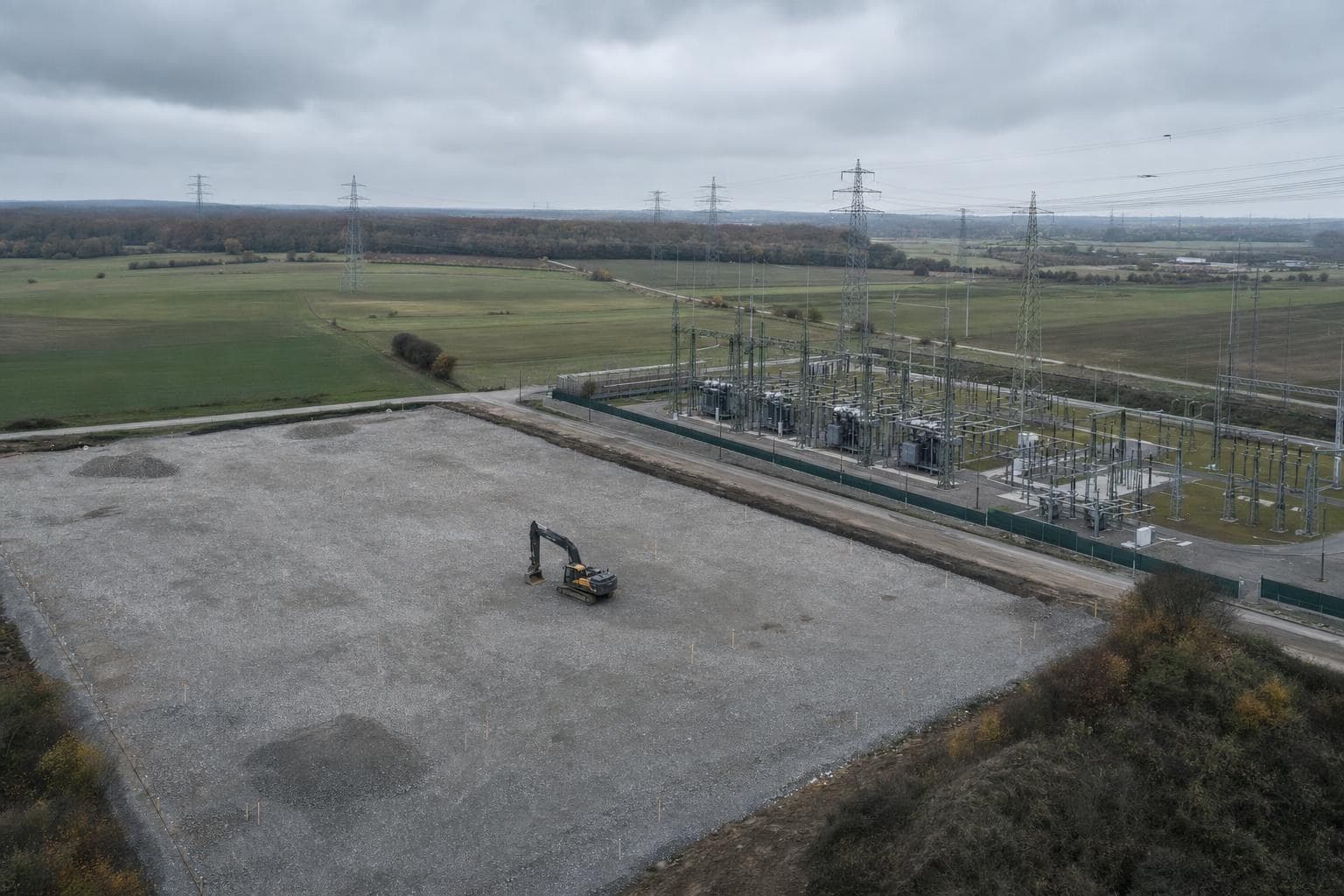
Bright & Green defines a search area and examines where grid capacity, land, fibre and a waste-heat customer come together. The enquiry to the grid operator precedes any discussion about land.
- Search area and grid capacity
- Preliminary check of land and zoning
- Fibre, water, waste-heat customer
Land & grid
The land is secured by purchase, lease or option, and in parallel Bright & Green files the grid connection request. The objective is a binding connection commitment from the grid operator.
- Purchase, lease or option
- Grid connection request
- Connection commitment
Permits
Land-use planning is conducted together with the municipality, followed by the building application and the studies on noise, traffic and the environment. Backup power is a permit matter of its own and is planned in from the outset.
- Development plan and planning consent
- Expert studies
- Backup power under emissions law
Energy concept
Battery storage, renewable generation, power purchase agreements and waste-heat delivery are sized to the connection capacity and to the requirements of the German Energy Efficiency Act.
- Storage at the connection
- Generation and power supply
- Waste heat and efficiency
Construction
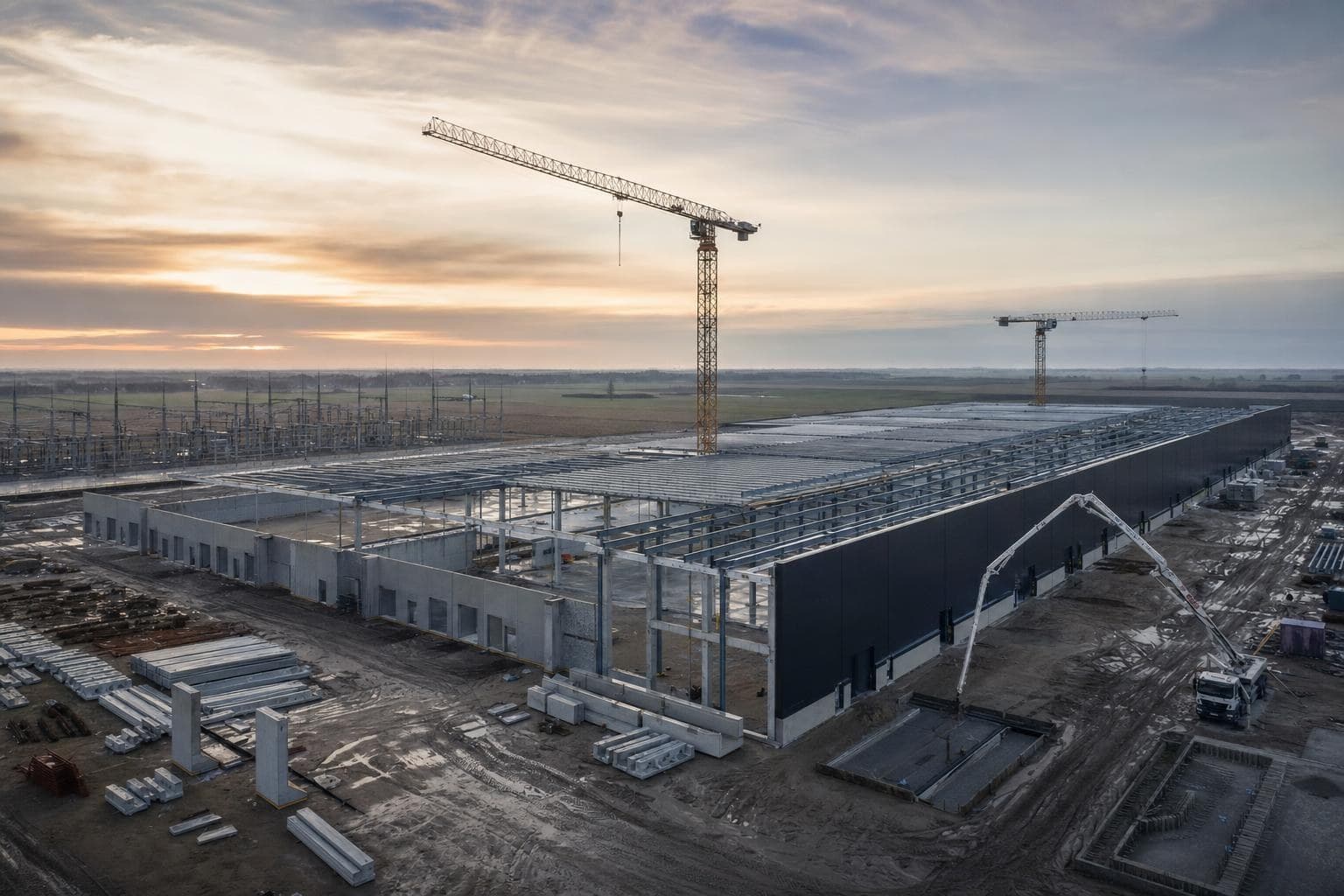
Construction covers the building shell, electrical systems, cooling, battery storage and the link to the substation. Bright & Green plans, tenders, manages the trades and takes them into acceptance.
- Planning and tendering
- Construction management
- Commissioning and acceptance
Operation
Bright & Green conducts operation itself: facility management, energy procurement, waste-heat delivery and the annual reporting obligations under the German Energy Efficiency Act.
- Facility management
- Energy and waste heat
- Reporting duties
Criteria for assessing a site
Eight criteria determine whether a plot becomes a data centre. The grid connection outweighs all the remaining criteria combined.
Land
The site requires a contiguous, level plot with reserve areas for battery storage, the substation and later expansion. The land requirement is considerably greater than for battery storage alone.
Grid proximity and substation
What matters is a high- or extra-high-voltage substation with free capacity within reach, or sufficient room for a dedicated substation. This criterion decides the site.
Fibre
The site requires redundant fibre connectivity over separate routes. Without it, even the best grid connection is of no use.
Planning status
Commercial or industrial zoning with a development plan already in place is preferable. Development remains possible without one, but takes longer, and Bright & Green makes that clear to the municipality in advance.
Water
Depending on the cooling concept, water is required for cooling and fire suppression. Bright & Green discloses the demand on its own initiative.
Waste-heat customer
A district heating network, an industrial plant or a new housing area should be located nearby. The German Energy Efficiency Act requires new data centres to reuse a share of their energy.
Distance to housing
Cooling and the backup power supply are audible. Sufficient distance to the nearest housing shortens the permitting procedure and eases the relationship with the neighbourhood.
Access
The site needs a road fit for heavy loads such as transformers and containers, as well as a traffic concept for the construction phase.
Permitting procedures in Germany
A data centre in Germany passes through four permitting procedures, which are conducted in parallel. Handling them one after another extends the timetable by years.
Land-use planning
The municipality creates the planning basis with a development plan (Bebauungsplan), designated as a commercial, industrial or special-use area. It holds the planning authority and consults the public and the statutory bodies.
Building permit
The building application is filed on the basis of the development plan and covers fire protection, structural design, drainage and the studies on noise, traffic and species protection.
Grid connection procedure
The procedure comprises the connection request to the responsible grid operator, the grid compatibility assessment, the connection commitment and the grid connection agreement, and follows a timetable of its own.
Backup power
A data centre's backup generators are combustion plants. Depending on their capacity, they require a permit under the German Federal Immission Control Act (BImSchG); they constitute a permit matter of their own and belong in the planning at an early stage.
The requirements for shovel-ready status
A site is shovel-ready only when all six requirements are in place. If one is missing, the result is a proposal rather than a site.
In this condition Bright & Green hands sites over to operators, and in this condition the company begins its own construction.
- Land secured – by purchase, lease or exercised option
- Binding connection commitment from the grid operator
- Planning consent through development plan and building permit
- Permit for the backup power supply
- Fibre connectivity secured
- Energy concept with storage, power supply and waste-heat delivery